esc

Search pages, or explore a browser-only workspace. Try help.

demos / quant-system blueprint

Quant-system blueprint

An asset-agnostic architecture illustrated with a crypto worked example: each stage has a contract to pass, and each rule is backed by a runnable experiment with a control.

Pick a stage to read the rule it must pass. Below are three of the experiments behind the rules, each measured against its own control.

The blueprint splits a quantitative research and trading system into nine typed stages. The architecture is asset-agnostic; this page demonstrates its crypto worked example. Each stage ships with conformance tests that any implementation must pass, and each test has a deliberately broken version it must catch. My crypto trading pipeline is a worked example: its data, feature, strategy and execution stages pass the blueprint's conformance tests, and its risk and sizing stages do not yet. Other asset classes are not implemented or validated by this demonstration.

00 infrastructure: One UTC clock, a point-in-time store and a kill switch that every other stage shares.
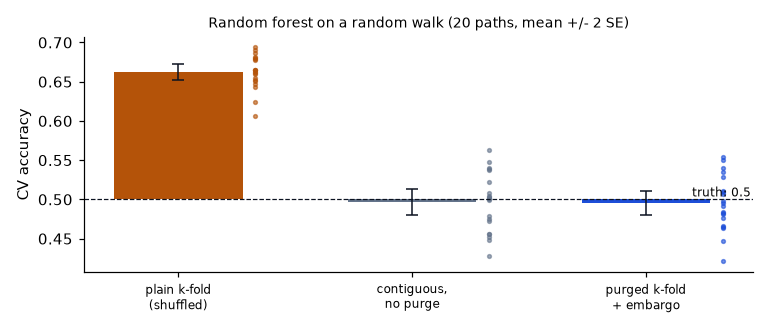
EXP-08-1: Shuffled cross-validation finds skill in noise
Shuffled cross-validation finds skill in noiseOn pure noise, shuffled k-fold scores 0.662 accuracy where the truth is 0.5; purged k-fold scores 0.495. The false skill comes from shuffling: contiguous folds without purging score 0.497, so purging adds nothing measurable in this setup.EXP-08-1 · synthetic random walk · supports its rule
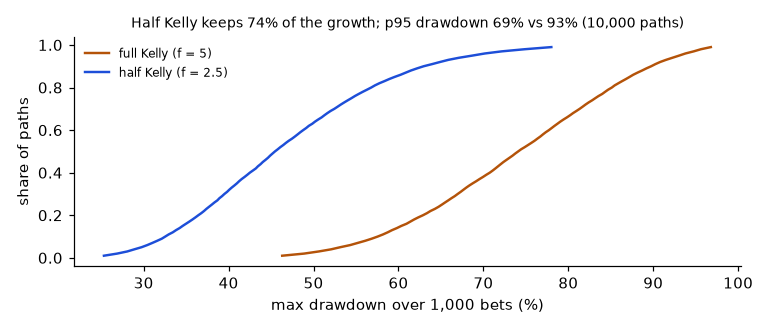
EXP-06-1: Half-Kelly keeps most of the growth
Half-Kelly keeps most of the growthWith the true edge, half-Kelly cuts the 95th-percentile drawdown from 93% to 69% and keeps 74% of full Kelly's median growth.EXP-06-1 · synthetic bets, 10,000 paths · supports its rule
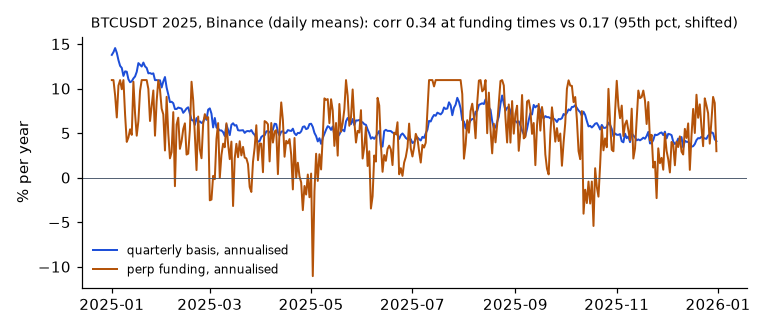
EXP-04-1: Funding tracks the futures basis
Funding tracks the futures basisOn public Binance data for 2025, annualised funding and basis correlate at 0.34 for BTC, against 0.17 at the 95th percentile when funding is shifted at random.EXP-04-1 · public Binance data, 2025 · supports its rule

16 of 20 experiments support their rule. The four that do not are reported in the repository's EVIDENCE.md. The thresholds were committed together with the first results, so they are not a pre-registration.